
01
Supply chain and delivery
Order locations, vehicle capacity, appointments, and pickup and delivery sequences affect each other. Model them together to compare routes, resource usage, and fulfillment costs.
What to model
Multiple depots, multidimensional capacity, pickup and delivery pairs, time windows, shifts, costs, and unserved jobs.
What you can evaluate
Who delivers each order, when they arrive, where conflicts occur, and how fleet size affects on-time delivery.
Where to test
Choose representative days and agree on a manual or system baseline. Compare distance, cost, delays, and stability.
02
Highway inspection and maintenance
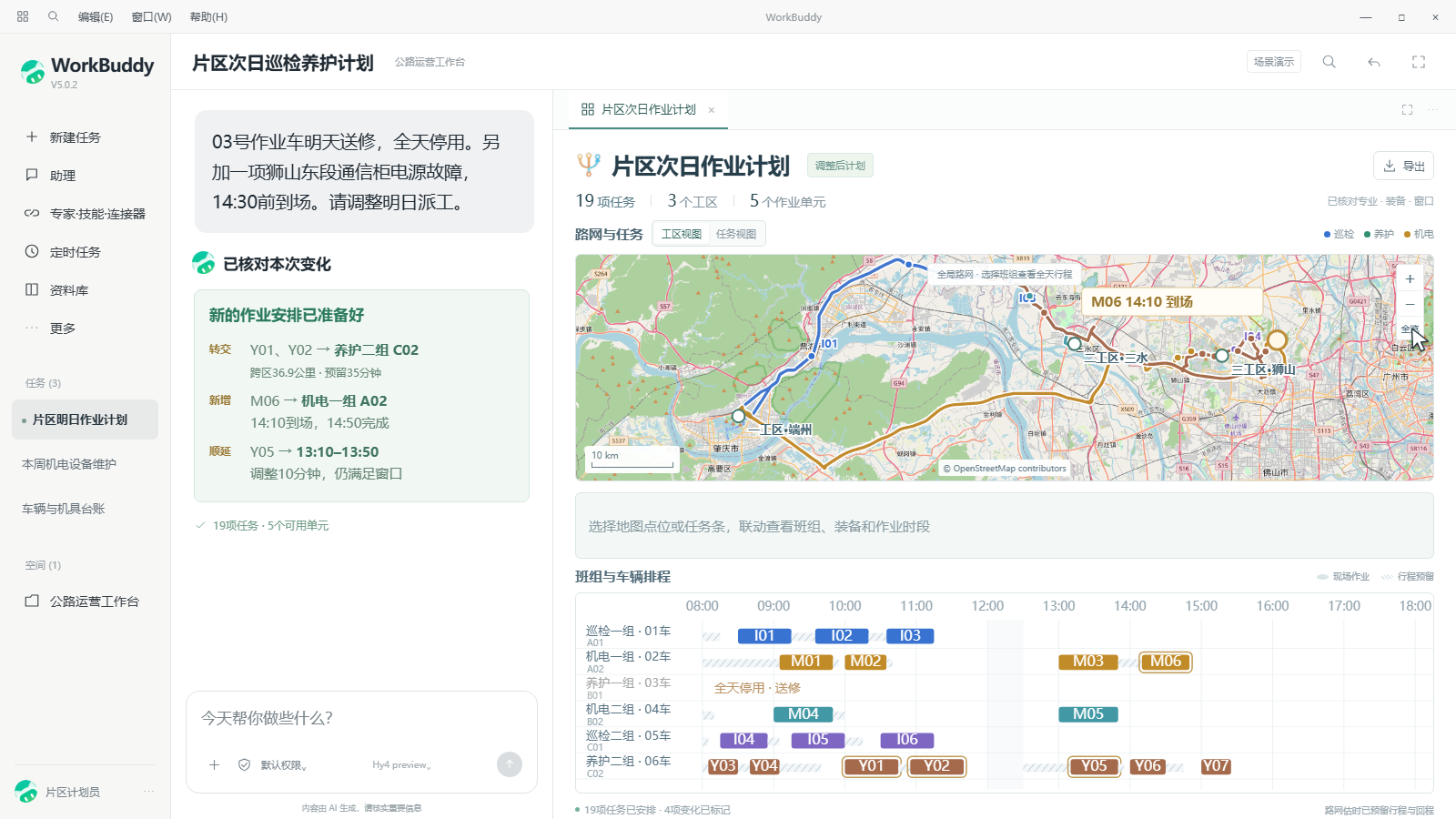
A nearby depot may lack the right skills or equipment. Plan inspections, maintenance, and electrical work with specialist crews, vehicles, equipment, locations, and work windows in view.
Changes to plan for
Vehicles taken out of service, urgent faults, cross-district support, delayed work, and new jobs.
Deliverables
Maps, crew schedules, qualification matches, and job views by district, crew, or vehicle.
About the demo
The Guangdong demo uses real roads and static travel estimates, with prebuilt plans. It contains no measured customer results.
03
Installation, repair, and field service
Model time, skills, qualifications, parts, and prerequisites for appointments, repairs, inspections, and parts movements. After dispatch, revise remaining work using actual locations, completed jobs, and new events.
- Preserve execution facts. Keep completed jobs, actual loads, and locked commitments when planning the remaining work.
- Explain unassigned work. Show whether an unassigned job needs more resources, a different time window, or a qualified crew.
- Approve before dispatch. Keep candidates separate from the active plan until approval.
Validate constraints and workflows on representative samples. An explainable score does not establish global optimality.
04
Other resource planning problems
Rostering, production scheduling, task assignment, and vehicle routing all model jobs, resources, constraints, and objectives. Each requires its own variables, search components, and validation.
Reusing methods across scenarios is on the research roadmap. A new engagement starts by checking representative samples and constraints before agreeing on scope.
Start with a concrete planning problem.
Contact the PsiAI team ↗