
01
Inside the workbench
Keep inputs, rules, plans, execution, and version history together in one scenario.
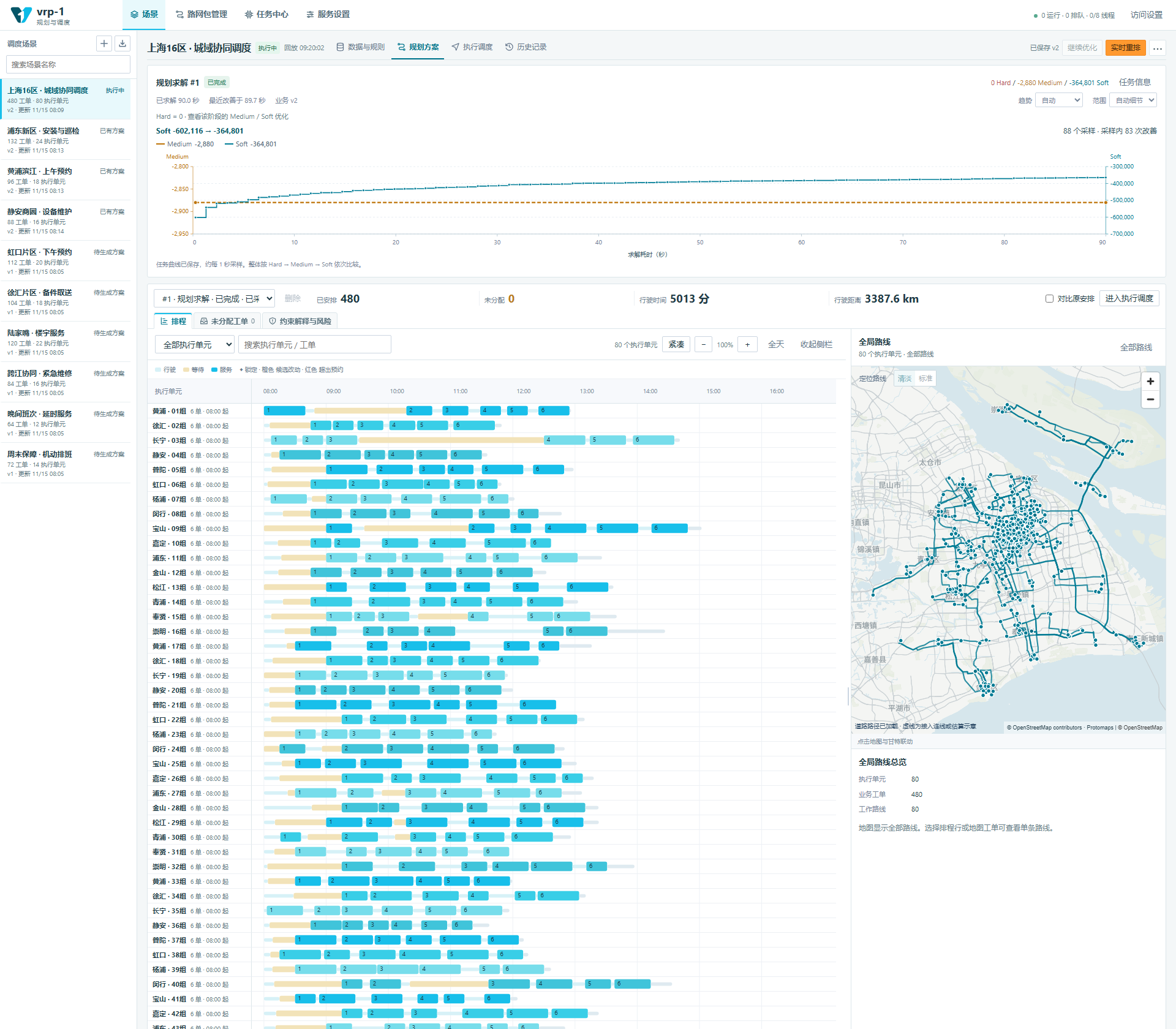
The map, Gantt chart, and score curve reflect the same plan. Open the full screenshot for details.
01 / 07Original Chinese-language screenshots from the vrp-1 README. The Shanghai demo spans 16 districts with 480 jobs and 80 resources. It uses real public geography and demo jobs, resources, and events. Select a screenshot to open it in full.
02
Model requirements for optimization
Jobs and resources
Work orders, operational units, locations, shifts, multidimensional capacity, skills, certifications, and multiple prerequisites.
Objectives and constraints
Specify hard constraints, business priorities, and cost preferences. Set parameters and weights for the scenario.
Geography and execution
Directed travel matrices by profile, road paths, actual execution, loading events, and locked commitments.
Edit scenarios, save versions, and work with tables. The solver uses the full problem, matrices, and parameters to return a plan, score, and structured explanation.
03
Planning, explanation, and replanning
- Planning. Heuristic search, warm starts, score curves, and linked maps and Gantt charts.
- Explanations. Inspect constraint matches, unassigned jobs, costs, and travel metrics. The final result is checked with independent full scoring.
- Manual refinement. Continue optimization or manually adjust assignments and stop order, then score the new candidate separately.
- Replanning. Use completions, new orders, cancellations, and faults to revise remaining work while preserving execution facts.
- Version history. Track scenario versions, frozen inputs, candidates, active plans, and execution snapshots.
The design and acceptance scope covers up to 1,000 work orders and 200 vehicles per run. Performance varies by instance. Heuristic search returns the best plan found within the budget.
04
Agents coordinate, optimization engines solve
Agents bring optimization into everyday work by clarifying requirements, confirming business rules, calling tools, and explaining results. The homepage demos use DeepSeek Harness and WorkBuddy. Authorization, tool interfaces, and embedding are adapted and tested for each platform.
The dark-theme demo draws on official workspace designs and uses the original brand icons. It pairs conversation with maps, schedules, and explanations from an existing scenario. Production solving and dispatch require an enabled integration and agreed platform, permissions, and interfaces.
APIs and MCP connect the tools. The workflow also needs scenario understanding, parameter adaptation, verification, and human review.
05
Delivery options by scenario
Standalone and self-hosted
A Rust solver core, CLI, isolated worker, HTTP service, and browser workbench for local or intranet use.
Business systems and APIs
Connect data, job status, and results through agreed interfaces with clear credentials, permissions, budgets, and error handling.
Platform and private deployment
Agree on job controls, tenant quotas, resources, versions, results governance, and any service levels for the deployment.
Delivery options include cloud service, API, private deployment, and self-hosting. Pricing, acceptance, maintenance, and data handling are agreed before activation.
Start with a concrete planning problem.
Contact the PsiAI team ↗