
THE MARS MISSION
Loading the 3D Mars scene
01 / ORBITAL PERSPECTIVEMars orbital preview
Film-inspired scenario

Compare scenarios

Rover power allocation

Rover route simulation

Route matrix

Planned distance, effective grade and max. grade
From → ToHABPathfinderAres IV
HAB0 km km km
Pathfinder km0 km—
Ares IV——0 km
→
Trip totalsDirect routeTerrain route
Distance km km
Eff. / max. grade / /
Total ascent km km
Terrain cost km km

Effective grade is distance-weighted, with extra weight on steep slopes. Ascent depends on direction and reflects motor work uphill. Cost uses equivalent flat km. Elevations come from MOLA. A dash marks an undefined leg.

DECISIONS BEYOND THE PLAN

Reality has
other plans.

Turn complex constraints into actionable plans

Starting with supply chains and fulfillment,
coordinate tasks, resources, and business constraints.

01/08

Scenario notes

Inspired by The Martian, the scenario runs 35 interdependent tasks. Each view shows the route, resource status, and parallel work. Timing, budgets, and communication windows follow the story.

The segmented rings show resource status. The thermal gauge shows warming or cooling. Neither is a measurement of stock, temperature, or safety. Labels identify each system or supply, and food inventory carries across all scenes and vehicles.

Mark, the automated base systems, the team on Earth, and Hermes work in parallel. Manual tasks compete for Mark’s time, and the rover and power supply have limits. An accident forces a reschedule. Mark can rest while the rover charges from its solar panels.

Base and rover power are allocated separately. The comparison shows how heating choices affect the power budget. Temperature control and range with a different heat source still need validation. Select an option to pause and inspect it, then return to the scenario.

The rover leaves the HAB in Acidalia to retrieve communications equipment from Pathfinder, then travels to Ares IV in Schiaparelli. The film puts the long journey at about 3,200 km. The map uses distance and slope to calculate routes offline. Gray dashes connect the endpoints, and the pale line shows cumulative progress. On the trek, Mark deploys the rover’s solar panels to charge and rest by day, then drives at night. The elevation grid is spaced about 1.85 km north to south and supports regional planning. The HAB and Ares IV have separate meter-scale scenes. Elevation data comes from NASA MOLA elevation archive。

Mark harvests and saves seed before the Pathfinder trip. The rover carries stored oxygen while the oxygenator and water recycler stay at the base. Decompression costs air, water, and cultivation capacity, but stored potatoes remain edible. Life support equipment moves into the rover for the longer journey. Driving and solar charging occupy separate windows, and RTG waste heat helps warm the cabin. After the MAV is stripped down, the spacesuit provides life support during ascent while Martinez pilots remotely.

The scenes condense the film’s timeline. Playback time is separate from the Martian sol count. The demo assumes a 12-minute one-way signal delay, along with defined communication windows, task durations, and budgets. Iris and later spacecraft supplies do not directly replenish Mark’s food on Mars.

Story and geography: Drew Goddard’s shooting script、NASA’s route notes. Base texture by Solar System Scope,CC BY 4.0, with softened color grading. Regional surface detail comes from NASA, JPL, and USGSViking MDIM 2.1, via NASA Trek, supplies localized texture detail. Elevation is separate. Near-field terrain is generated. This fictional scenario illustrates planning concepts and does not represent a real mission or a delivered PsiAI capability.

BUSINESS × AI × OPTIMIZATIONResources have limits / Plans meet change / Decisions with evidenceExplore real operations

02 Scenario-based optimization

Explore our methods ↗

Start with the problem
Shape the search

Identify bottlenecks in resources, timing, and dependencies.
Tailor the search to the specific problem.

Business structure, bottlenecks, and candidate search methodsIn this teaching example, only A qualifies for J2 and J3 after B leaves. A works on J1 until 09:20, leaving six minutes of slack after the direct trip to J2. J3 must wait for J4. J5 is fixed to C and J6 equipment is already on C. Scarce-resource-first construction and joint repair are research hypotheses that need independent evaluation.01Model dependenciesJobs, resources, and execution factsAElectrical EBElectrical ECGeneral workJ1 until 09:20Unavailable at 09:00J5 fixedJ6 equipment loadedCan do J4J2 / Cert. E09:40–09:50J3 / Cert. E10:15–10:45J4 / PrerequisiteBefore J3 startsDependency across crews02Find bottlenecksFind the dependencies that matterScarce qualificationsOnly A qualifies for J2 and J3A and B initially have electrical certificationTime slack09:44 arrival · 6 min spareA frees up at 09:20 + 24 min travelExecution and dependenciesKeep J1, coordinate J3 and J4Fixed assignments, cargo, and movable jobs03Design search methodsUse existing solver toolsImplementedWarm start → Local search → Verifyrelocate / swap / Or-opt · Late AcceptanceDesign for the bottleneckResearchTurn hypotheses into search stagesScarcity-firstLocal refinementRemove / RepairStart method · Operators · Search stages · Budget Business relationships, bottlenecks, and candidate methods A and B both have electrical certification. When B becomes unavailable, only A remains. A is committed to J1 until 09:20 and can arrive at J2 at 09:44, six minutes before the latest start. J4 precedes J3. C keeps its fixed assignment and equipment. The solver can use existing components. Methods designed for this bottleneck still need evaluation. 01Job dependencies09:00 · Resource changeA · Electrical EJ1 locked to 09:20B · Electrical EUnavailable at 09:00C · General workJ5 fixed · J6 on CEligibleJ2 · Cert. E09:40–09:50J3 · Cert. E10:15–10:45J4 · PrepPrerequisite for J3J3 waits for J402Find bottlenecksBefore B leaves, A and B can do electrical workOnly A qualifies for J2 and J3A leaves J1 at 09:20 · 24 min to J209:44 arrival6 min spareJ2 latest start 09:50Coordinate J3, J4, and competing jobsJ1 locked · J5 reorderable · J6 stays assigned03Design search methodsUse existing componentsWarm start → Local search → Verifyrelocate / swap / Or-opt · Late AcceptanceBottleneck-based search · ResearchScarcity-first → Refine → Remove / RepairTest initialization, operators, order, and budget Business relationships, bottlenecks, and candidate methods A and B both have electrical certification. When B becomes unavailable, only A remains. A is committed to J1 until 09:20 and can arrive at J2 at 09:44, six minutes before the latest start. J4 precedes J3. C keeps its fixed assignment and equipment. The solver can use existing components. Methods designed for this bottleneck still need evaluation. 01Job dependencies09:00 · Resource changeA · Electrical EJ1 locked to 09:20B · Electrical EUnavailable at 09:00C · General workJ5 fixed · J6 on CEligibleJ2 · Cert. E09:40–09:50J3 · Cert. E10:15–10:45J4 · PrepPrerequisite for J3J3 waits for J402BottlenecksA and B initially qualifyOnly A qualifies for J2 and J3A leaves J1 at 09:20 · 24 min to J209:44 arrivalLatest 09:50 · 6 min spare03Design search methodsExisting toolsWarm start → Local search → Verifyrelocate / swap / Or-opt · Late AcceptanceResearch candidateScarcity-first → Refine → Remove / RepairCoordinate J3/J4, retain locks, assignments, equipment Business relationships, bottlenecks, and candidate methods A and B both have electrical certification. When B becomes unavailable, only A remains. A is committed to J1 until 09:20 and can arrive at J2 at 09:44, six minutes before the latest start. J4 precedes J3. C keeps its fixed assignment and equipment. The solver can use existing components. Methods designed for this bottleneck still need evaluation. 01Job dependencies09:00 · Resource changeA · Electrical EJ1 locked to 09:20B · Electrical EUnavailable at 09:00C · General workJ5 fixed · J6 on CEligibleJ2 · Cert. E09:40–09:50J3 · Cert. E10:15–10:45J4 · PrepPrerequisite for J3J3 waits for J402BottlenecksA and B initially have electrical certificationOnly A qualifies for J2 and J309:20 + 24 min → 09:446 min spareLatest start 09:50 · J5 reorderable · J6 keeps its assignment03Design search methodsExisting toolsWarm start → Local search → Verifyrelocate / swap / Or-opt · Late AcceptanceResearch candidateScarcity-first → Refine → Remove / RepairCoordinate J3/J4, keep locks, assignments, equipment

Teaching example from Section 10 of the technical document. The six-minute buffer comes from the given travel time. The candidate method still needs evaluation.

03 Solver evaluation

Benchmarks ↗

From workflow to solver benchmarks

Start with work orders, travel matrices, and actual execution.
Check solution quality with independent scoring and benchmark curves.

vrp-1 workflow, solver core, and benchmarks Model the scenario, prepare geography, plan and explain, validate and adopt, then replan during execution. The core uses neighborhood search and incremental scoring followed by independent full scoring. The first synthetic benchmark compares cold starts and continuation from identical routes under a fixed budget. Lines show the median observed best-solution events and shading shows the range across five seeds. Costs enter the charts once every seed is fully assigned with zero hard violations. Workflow ModelJobs, resources, sitesWindows, skills, prerequisites Prepare mapsRoad version and travel matrixBuild road paths by job Plan and explainCold or warm startGantt, map, explanations Verify & adoptCheck execution and loadsActivate after approval Execution and replanningDepart, arrive, serve, finishReplan when events arriveSolver corevrp-core · RustFreeze inputsScenario version and matrixPin execution baselineInitial solutionBuild from scratchOr start from existing routesNeighborhood search and scoringrelocate / swap / Or-optHard → Medium → SoftIndependent full scoringVerify constraint scoresExplain the planSynthetic benchmarks30 s · 1 thread · 5 seedsDriving hours ↓ vs. solve time (s), including setupvrp-1vrp-0a01 · Basic deliverya02 · Dense urbana03 · Four depotsa04 · Larger scalea05 · Skills and capacitya06 · Tight windowsCold starts1.51.7522.2501530−14.95%11.522.501530−31.82%1517.52001530−7.14%10012515001530−31.93%67801530−2.82%22.501530−6.54%Continue from identical routes23401530−8.08%1234501530−26.51%20304001530−9.72%10012515017501530−17.96%57.51012.51501530−5.03%22.5301530−11.50% vrp-1 workflow, solver core, and benchmarks Model the scenario, prepare geography, plan and explain, validate and adopt, then replan during execution. The core uses neighborhood search and incremental scoring followed by independent full scoring. The first synthetic benchmark compares cold starts and continuation from identical routes under a fixed budget. Lines show the median observed best-solution events and shading shows the range across five seeds. Costs enter the charts once every seed is fully assigned with zero hard violations. Workflow ModelJobs, resources, sitesWindows, skills, prerequisites Prepare mapsRoad version and travel matrixBuild road paths by job Plan and explainCold or warm startGantt, map, explanations Verify & adoptCheck execution and loadsActivate after approval Execution and replanningDepart, arrive, serve, finishReplan when events arriveSolver corevrp-core · RustFreeze inputsScenario version and matrixPin execution baselineInitial solutionBuild from scratchOr start from existing routesNeighborhood search and scoringrelocate / swap / Or-optHard → Medium → SoftIndependent full scoringVerify constraint scoresExplain the planSynthetic benchmarks30 s · 1 thread · 5 seedsDriving hours ↓ vs. solve time (s), including setupvrp-1vrp-0a01 · Basic deliverya02 · Dense urbana03 · Four depotsa04 · Larger scalea05 · Skills and capacitya06 · Tight windowsCold starts1.5201530−14.95%1201530−31.82%1517.52001530−7.14%10015001530−31.93%6801530−2.82%22.501530−6.54%Continue from identical routes23401530−8.08%2401530−26.51%20304001530−9.72%10015001530−17.96%5101501530−5.03%2301530−11.50% vrp-1 workflow, solver core, and benchmarks Model the scenario, prepare geography, plan and explain, validate and adopt, then replan during execution. The core uses neighborhood search and incremental scoring followed by independent full scoring. The first synthetic benchmark compares cold starts and continuation from identical routes under a fixed budget. Lines show the median observed best-solution events and shading shows the range across five seeds. Costs enter the charts once every seed is fully assigned with zero hard violations. WorkflowModelJobs and constraintsPrepare mapsRoad network and matrixPlan and explainSolve and explainVerify & adoptActivate after checksExecution and replanningReplan remaining jobsSolver coreFreeze inputsVersions and matricesInitial solutionCold / Warm startNeighborhood search and scoringHard → Medium → SoftIndependent full scoringCheck scores and explanationa03 · Four depots30 s · 1 thread · 5 seedsvrp-1vrp-0Cold starts−7.14%1517.52001530Continue from identical routes−9.72%20304001530Driving hours ↓ / Solve time (s) with setup vrp-1 workflow, solver core, and benchmarks Model the scenario, prepare geography, plan and explain, validate and adopt, then replan during execution. The core uses neighborhood search and incremental scoring followed by independent full scoring. The first synthetic benchmark compares cold starts and continuation from identical routes under a fixed budget. Lines show the median observed best-solution events and shading shows the range across five seeds. Costs enter the charts once every seed is fully assigned with zero hard violations. WorkflowModelJobs and constraintsPrepare mapsRoad network and matrixPlan and explainSolve and explainVerify & adoptActivate after checksExecution and replanningReplan remaining jobsSolver coreFreeze inputsVersions and matricesInitial solutionCold / Warm startNeighborhood search and scoringHard → Medium → SoftIndependent full scoringCheck scores and explanationa03 · Four depots30 s · 1 thread · 5 seedsvrp-1vrp-0Cold starts1517.52001530−7.14%Continue from identical routes20304001530−9.72%Driving hours ↓ / Solve time (s)

First synthetic benchmark for vrp-1. Curves begin once all five seeds have fully assigned plans with zero hard violations. Costs are plotted from best-solution events.

04 vrp-1 · Vehicle routing and scheduling

Original workbench screenshots

Understand the plan. Track each change

Work with rules, maps, and schedules, then explain, compare, and revise plans as work unfolds.

Explore the product
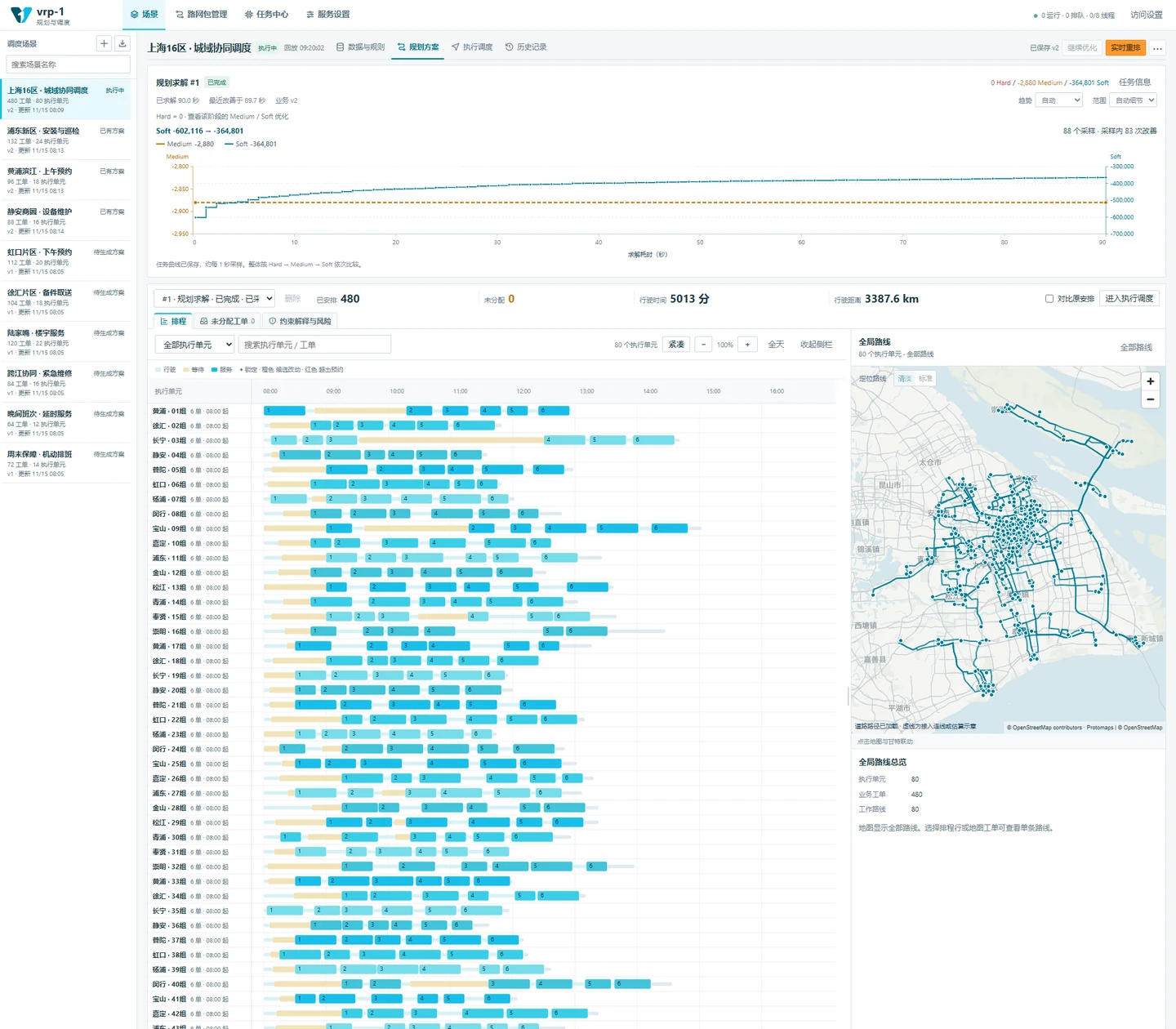
Shanghai demo across 16 districts with 480 jobs and 80 resources. The geography uses public data. Jobs, resource settings, appointments, and execution events were created for the demo.

Original screenshots

05 AI agents

Plan and adapt through conversation

Start with two source files. Ask why, adapt the plan,
and get the new schedule to the people who will carry it out.

Loading the agent demo
DeepSeek Harness
Highway operations / Next-day planInteractive demo
Next-day work planConversation / PsiAI

Guangdong demo data and prebuilt plans. Platform integrations vary.

Explore integration ↗

06 System design

System details ↗

From business needs
to continuous delivery

Agents coordinate the work. The runtime manages jobs and solvers perform the optimization.
Feedback informs testing before capabilities return to production.

Online planning, offline solver improvement, and feedback between the two loopsOnline decisions and collaborationAgents coordinate before and after solving Intake and workflowsCustomer systems / API / Chat / DataIntake routingSelect workflow, interpret requirements, adapt parametersSolver routingEngine, strategy, version, budgetBefore production, verify rules, access, and key business requirementsDecision RuntimeAccess · Jobs · Resources · State · ResultsVerify assets → Pin versions → Monitor runsScenario solverIsolated run · Algorithms / Operators / Dependencies Explain, compare, refineCompare plans and trade-offsDiagnose / Adjust / RerunApproval and execution feedbackAdopt, replay results, capture changesAdjust parameters and constraints, then rerunExternal maps / Travel matricesOffline solver improvementOffline trials · Automated evolution in researchApprove, promote, registerPublished workflows / Engines / RoutingIsolated build and scenario testsSimulate · Benchmark · CompareCandidate models, algorithms, workflowsPropose · Generate · ReviseSamples and regression setsResults / Diagnostics / AdjustmentsExecution feedbackApproved assets feed intake and solver routingShared governanceAudit · Versions · Data rights · Security · Cost and quotas · Asset lineageInfrastructure · Compute · Network · Storage · Registry · Telemetry Online planning, offline improvement, and shared governance Intake routing selects a workflow. Solver routing picks the engine and strategy. The Decision Runtime controls jobs, and scenario engines run in isolation. Production feedback goes into offline regression sets. After isolated testing and human approval, published assets return to both routers. Shared governance and infrastructure support both loops. Online decisions and collaborationOffline solver improvement Intake and workflowsSystems / API / Chat / DataIntake routingSelect published workflowAdapt scenarioObjects, parameters, constraints, acceptanceSolver routingEngine, strategy, version, budgetCheck rules, access, and key requirementsDecision RuntimeVerify assets · Pin versionsManage resources, jobs, stateScenario solverRun in isolationManage algorithms, moves, resultsExternal maps / Matrices Explain, compare, refine, and approveCompare trade-offs, diagnose, adjust, and solve againAdopt plans, replay results, collect feedback04Approve, promote, registerHuman approval · Publish for both routers03Isolated build and scenario testsSimulate · Benchmark · Compare02Candidate models, algorithms, workflowsPropose, generate, mutate, repair01Samples and regression setsResults, diagnostics, and adjustmentsExecution feedbackShared governanceAudit, versions, data rights, security, cost, quotas, and asset lineageInfrastructureCompute, network, storage, registry, telemetry Online planning, offline improvement, and shared governance Intake routing selects a workflow. Solver routing picks the engine and strategy. The Decision Runtime controls jobs, and scenario engines run in isolation. Production feedback goes into offline regression sets. After isolated testing and human approval, published assets return to both routers. Shared governance and infrastructure support both loops. Online decisions and collaborationSystems / API / ChatIntake routingSelect published workflowAdapt scenarioParameters, constraints, goalsSolver routingEngine, version, strategy, budgetCheck rules, access, and requirements before runningDecision RuntimePin version · Schedule jobScenario solverIsolated run · Return resultsExternal maps / MatricesExplain, compare, refine, and approveDiagnose · Adjust · RerunOffline solver improvementFeedback feeds regression testsApprove and promoteRegister assets · Both routersSamples and regressionResults, diagnosis, editsIsolated build and evaluationSimulation and benchmarksGenerate candidatesModels, algorithms, workflowsGovernance · Audit, versions, rights, security, quotas, lineageInfrastructure · Compute, network, storage, registry, telemetry Online planning, offline improvement, and shared governance Intake routing selects a workflow. Solver routing picks the engine and strategy. The Decision Runtime controls jobs, and scenario engines run in isolation. Production feedback goes into offline regression sets. After isolated testing and human approval, published assets return to both routers. Shared governance and infrastructure support both loops. Online decisions and collaborationSystems / API / ChatIntake routingSelect published workflowAdapt scenarioParameters, constraints, acceptanceSolver routingEngine, version, strategy, budgetCheck rules, access, and requirements before runningDecision RuntimePin version · Schedule and monitorScenario solverIsolated run · Return resultsExternal maps / MatricesExplain, compare, refine, and approveDiagnose · Adjust · RerunOffline solver improvementApprove, promote, registerHuman approval · Publish for both routersIsolated build and scenario testsSimulate · Benchmark · CompareCandidate models, algorithms, workflowsPropose, generate, mutate, repairSamples and regression setsResults, diagnostics, operations feedbackExecution feedbackGovernance · Audit, versions, rights, security, quotas, lineageInfrastructure · Compute, network, storage, registry, telemetry

Candidates are tested offline. Automated method evolution is an area of research.

07 Use cases and results

Explore use cases ↗

Built for supply chains
and beyond

Plan tasks, people, vehicles, and time together.
Balance operating costs, customer experience, and workloads in the field.

Historical delivery case

2025 · Metrics ↗
Total transport cost−30%
Late deliveries−80%
Total distance−47%
Total delivery time−9.3%
Vehicles used−18%
Empty-running rate−10.9%

Six figures from the historical record. The sample, dates, baseline, and calculation methods are pending verification, including whether empty-running rate is measured in percent or percentage points. These results are separate from the Shanghai and Guangdong demos and do not predict results in other industries.

08 Industry recognition

More coverage ↗

Awards and press

Competition awards and public coverage in supply chains, transportation, and the digital economy.

Competition awards 2024—2025
2025 AI Pioneer Cup certificate, third prize in transportation. Participant names have been removed.Loading the certificateAI Pioneer CupAI in transportation
Third prize · 2025

2025 China Artificial Intelligence Competition certificate, Grade B in the supply chain case track.Loading the certificateChina AI CompetitionSupply chain case track
Grade B certificate · 2025

2024 Innovation Silicon Alley competition certificate, third prize in the AI and digital economy seed group.Loading the certificateInnovation Silicon Alley · DongchengAI and the digital economy
Seed group, third prize · 2024

View full image

Loading the full image

Scroll to zoom · Drag to pan